Showing posts with label World Vegetarian Classics. Show all posts

Thursday, October 4, 2012

Vegan MoFo - Stopover 4 - Indonesia


Indonesia was another easy one for me, the meal was planned as soon as the country was drawn! Long time readers of this blog may recall that I struggled to enjoy tempeh for a while before finding some burgers and lasagne that I loved and even after all this time I'm still a bit wary about trying out new tempeh recipes. As tempeh originates from Indonesia I simply had to be brave and delve into a tempeh dish. A recipe called Oseng Oseng Tempe (Fried spiced tempeh) had been on my list to try for ages which is from World Vegetarian Classics by Celia Brooks Brown.

This has been one of my favourite cookbooks for years and definitely the most utilised non-vegan cookbook on my shelf these days. Celia's recipes have rarely left me disappointed, the photography is gorgeous and it covers food from so many countries. Up until now I had only made one of the Indonesian recipes which was a fantastic rendang curry using jackfruit during MoFo last year which still remains as my favourite way to eat jackfruit.

Oseng Oseng Tempeh is a simple dish of thinly sliced tempeh strips shallow fried in oil with shallots and is served with a delicious spicy mixture of cayenne pepper, soy sauce, lime juice, sugar and tomato paste. After the slices were fried there was none of that weird taste I'm not fond of and the young man who is an even bigger tempeh sceptic than me also gave it the thumbs up! I served this with Nasi Goreng (Indonesian fried rice) which was also from World Vegetarian Classics as it's such a typical Indonesian dish and it seemed like a perfect partner for the tempeh. I'm pretty fussy when it comes to this sort of thing and this recipe needed a bit more spice for my liking so I'll probably tweak it a little next time. An interesting note in the cookbook states how it is best to use long grain rice that has been cooked 2-3 hours in advance for Nasi Goreng, fresh rice is no good neither are leftovers that have been sitting in the fridge overnight.

_______________________________________________________________________________________

Did you know?

Most people are aware that there are several volcanoes spread across the islands of Indonesia but how many of you have heard of Mount Kelimutu? It is a unique volcano which contains 3 summit crater lakes that are coloured blue, green and red.


Do you want to know where else I've been this month? Click here for the round up.

Tuesday, August 7, 2012

Borscht and pretzels


Borscht has been on my cooking to-do list for such a long time. I'm not quite sure why I wanted to try it so badly, was it the brilliant colour calling out to me or an opportunity to build up my repertoire of beetroot recipes? Certain things about borscht didn't really appeal to me, like serving it cold. Chilled soups are something I'm yet to get my head around and muster the guts to try, perhaps on a hot summer day when it makes a bit more sense. Warm hearty soups are what I need in the middle of winter in Melbourne.

I had been eyeing off a borscht recipe in World Vegetarian Classics for ages yet it seemed a bit too chunky for my liking. A few weeks ago Johanna posted a version that was mostly blended, I preferred the sound of this texture so I used both sources for inspiration and came up with something in between the two. Cashew based creams have been my preferred replacement for dairy sour cream for ages but as there was some silken tofu that needed to be used quickly I whizzed up a tofu/cashew cream to serve with the soup instead.


After sampling pretzels at Gasometer recently, I was keen to give them a try at home and tracked down a recipe on Peas and Thank You. This seemed like the perfect occasion to make them! I was playing a dangerous game by serving soup for dinner (which is generally frowned upon) and thought that some freshly baked pretzels might win me back some brownie points.


Mama Pea's recipe was written using a stand mixer with a dough hook which I don't own so I changed the process around to suit a traditional kneading method and used my prior bread making knowledge and judgement at times. After the dough had been kneaded, rested, rolled out and shaped, the pretzels had to be boiled for 30 seconds prior to baking. This is similar to a step I've read about in bagel recipes. The only problem was that I forgot to add bicarbonate of soda to the boiling water which is supposed to give the pretzels their shine and colour!


Similar to Gasometer's pretzels, I topped mine with coarse sea salt and caraway seeds and served them with vegan mustard butter - a mixture of dairy free margarine and seeded mustard. The boys weren't very keen on the soup but they loved their pretzels. Borscht isn't going to become one of my favourite soups but I did enjoy it's earthy flavour and was happy to eat the leftovers for lunches. On the other hand the pretzels were an absolute highlight that I'll definitely have to make again, perhaps a little shinier next time.     


Borscht - Beetroot soup with kidney beans and cabbage (Adapted from Green Gourmet Giraffe and World Vegetarian Classics)

1 onion, diced
3 cloves garlic, diced
3 medium (500g) beetroot, diced
1 large (200g) potato, diced
1 large (200g) carrot, diced
4 cups water
2 teaspoons salt
1 x 400g tin red kidney beans, drained and rinsed
¼ small head green cabbage, finely shredded
1 tablespoon red wine vinegar
300g silken tofu
½ cup cashews
2 tablespoons lemon juice
1 teaspoon salt
Finely chopped fresh dill, for garnish
Freshly cracked black pepper

Place the onion, garlic, beetroot, potato, carrots, water and salt in a stockpot and bring to the boil. Reduce the heat to low and simmer, covered, for 1 hour.

Meanwhile place the tofu, cashews, lemon juice and salt in a blender and process until no chunks of cashews remain. Transfer the contents to a bowl and refrigerate. Rinse out the blender.

After the soup has simmered for an hour, transfer batches to the blender and process until smooth. Return the blended soup to the stockpot and reheat gently. Add the kidney beans, cabbage and red wine vinegar and cook for a further 5 minutes or until the cabbage has just softened. Serve garnished with the tofu/cashew cream, dill and freshly cracked black pepper.


Pretzels (Adapted from Peas and Thank You)
Makes 4 large pretzels

1 teaspoon salt
2 teaspoons raw sugar
1 teaspoon dried yeast
¾ cup lukewarm water
2 ½ cups plain flour
2 tablespoon dairy free margarine, melted
10 cups water
2/3 cup bicarbonate of soda (I forgot to add it this time!)
Coarsely ground sea salt
½-1 teaspoon caraway seeds

Dissolve the salt and sugar in a jug containing ¾ cup lukewarm water and sprinkle the yeast on top. Allow to sit for about 5 minutes or until the yeast starts to look foamy.

Place the flour in a large bowl and make a well in the centre. Pour the contents of the jug into the well, followed by the margarine and mix the ingredients with your hands to form a rough dough. Turn the dough out onto a clean floured bench and knead for at least 5 minutes or until the dough is soft and supple. Rest the dough in an oiled bowl covered with a tea towel for 1 hour or until the dough has doubled in size.

Cut the dough into 4 equal sized pieces. Roll each piece of dough out into long thin strands using your hands, each piece should be approximately 60cm long. Shape each piece of dough into a pretzel knot and press the knots together gently so they do come apart during the boiling process.

Preheat oven to 230C. Bring 10 cups of water plus 2/3 cup bicarbonate of soda to the boil and line an oven tray with baking paper (I didn't use baking paper and one of the pretzels stuck to the oiled tray so I would highly recommended using it). Gently lower a pretzel into the boiling water and allow to cook for 30 seconds. Remove carefully with a slotted spoon and place on the oven tray. Repeat for the other 3 pretzels.

Bake the pretzels in the oven for 12-14 minutes until golden brown.

Thursday, October 20, 2011

Vegan MoFo - R is for Rendang Nangka


R was a difficult letter because I couldn't decide what to make. Rice paper rolls were my original idea as I have wanted to make them for a long time and then I thought about making a risotto but that seemed a little mundane. On the morning I was due to cook something for R, I read this interesting post on I Eat Grains! about how green jackfruit has a very meaty texture and neutral taste and decided to try it out in a Rendang curry. I even stumbled across a rendang recipe using jackfruit in my copy of World Vegetarian Classics by Celia Brooks Brown.

World Vegetarian Classics contains chapters of regions around the world and each chapter starts with a page about an expert in the regions cuisine. I was interested to find that the expert for South-East Asia was Sri Owen, a cookbook author that Cindy and Michael from Where's the Beef have been posting about in recent times. Cindy and Michael have posted a Sri Owen recipe for rendang using tempeh instead of beef which apart from being doubled in quantities looked very similar to the ingredients in my cookbook. The main difference between these recipes was the latter part of the method.

Cindy and Michael mentioned a few tweaks they would make next time around which was to increase the ingredients in the spice paste and/or reduce the amount of coconut so I took this on board and altered the World Vegetarian Classics recipe a bit. I used the stated amount of chilli but decided the leave the seeds in to make it spicier, increased the shallots, garlic, ginger and galangal and cut back on the coconut milk a little.

Reducing the coconut milk decreased the cooking time by about 30 minutes which was fantastic as the curry still took a good 2 hours to cook. The initial preparation doesn't take very long but once that is out of the way, it's just a matter of stirring every now and then. After about an hour, a crust develops on the bottom of your pot which you need to scrape off a few times and mix in with the sauce. These crusty bits were a highlight of the curry as they contained so much flavour.

The man and I were so impressed with the jackfruit in this rendang, my son was a little less enthused about the jackfruit but still liked the curry. The texture of the jackfruit was rather meaty and the pieces were mostly intact after 2 hours of cooking. I think jackfruit is a great mock meat alternative for gluten and/or soy free people and it's something I will use more often, perhaps in my "butter chicken" next time. You can find green jackfruit in tins at asian groceries but be aware that they also sell ripened jackfruit in syrup which is sweeter and softer and wouldn't produce the same result.

The rendang was served with basmati rice and choy sum steamed with minced garlic drizzled with a touch of sesame oil at the end.


Click here to see my A - Z of Vegan MoFo posts.


Rendang Nangka (Adapted from World Vegetarian Classics with some tips taken from Where's the Beef)

4 shallots, roughly chopped
4 garlic cloves, roughly chopped
3cm piece of ginger, roughly chopped
3 red chillies, roughly chopped
1cm piece galangal, roughly chopped
2 x 400ml tins coconut milk
1/2 teaspoon turmeric
1 bay leaf
1 stalk lemongrass, outer layer removed
1 teaspoon salt
2 x 540g tins green jackfruit in brine, drained and rinsed
1 x 400g tin chickpeas, drained and rinsed
 
Place the shallots, garlic, ginger, chillies and galagal into a blender with about 1/4 cup of the coconut milk and process until smooth. Pour the blender mixture into a large pot along with the rest of the coconut milk, turmeric, bay leaf, lemongrass, salt and jackfruit and bring to the boil.

Lower the heat to medium and allow it to simmer, uncovered for about 90 minutes, stirring occasionally. After 60 minutes the gravy will become very thick and will require more frequent stirring. A crust will begin to form on the bottom of your pot which should be scraped with a metal spatula to allow a new one to form. After scraping the crust a few times, the gravy should be almost totally absorbed by the jackfruit. Add the chickpeas and cook for a further 30 minutes, scraping the crust a few more times. There should be no liquid remaining. Remove the lemongrass and bay leaf before serving.

Friday, October 7, 2011

Vegan MoFo - G is for Glamorgan Sausages


Glamorgan Sausages or Selsig Morgannwg in the Welsh tongue are credited with being the first vegetarian sausages according to my copy of World Vegetarian Classics by Celia Brooks Brown. They can be traced back to 1862 where they were highly regarded by George Burrows in his diary about his travels through Wales. The original cookbook recipe consists of breadcrumbs, leeks, parsley, eggs, cheese, mustard and seasonings which is obviously not vegan. My husband and son adored these sausages during our period as vegetarians so I took it upon myself to attempt a vegan version several months ago which they both deemed to be a success.

By substituting a vegan cheese for dairy cheese with a bit of nutritional yeast thrown in for good measure and ground flaxseeds mixed with water for eggs, the mixture actually binds together better than the original version. They are not strongly flavoured so I recommend serving them with a nicely spiced tomato chutney or mustard. Tomato sauce/ketchup or BBQ sauce is another condiment that works well with them.

I actually prefer my meals to have a bit more oomph than these snags and mash but they have been requested for quite some time so I made them to please the man and son. To keep it interesting for me this time, I stir-fried some julienned carrots and shredded cabbage with garlic, chilli and vegan mushroom oyster sauce to have on the side. Next time around I may try adding a bit of smoked paprika to the sausage mixture as it's a spice I adore and feel could make them more interesting.


Click here to see my A - Z of Vegan MoFo posts.

Friday, September 2, 2011

Ethiopian dinner party


After the success of the Mexican fiesta a few weeks ago, I invited my Dad and family from his second marriage over for a meal. This time my plan was to cook some Ethiopian food as I thought it would be something they would appreciate not having tried it previously.

A few weeks prior, I was delighted to find that my health food store had just begun stocking teff flour. I had been searching high and low for this authentic ingredient for some time and to have it magically appear after I had given up all hope was a lovely surprise. My previous injera attempt which I never got around to posting about was using red sorghum flour which is supposed to be the best alternative to teff flour. This injera recipe from The Sour Dough is the updated recipe I have been using which has worked well with both red sorghum and teff flours.

For the stews (which are really more like curries), I cooked up a double batch of our favourite powdered chickpea stew and a mixed vegetable stew with pumpkin, broccoli and cauliflower, both from World Vegetarian Classics by Celia Brooks Brown. I also made a couple of other stews trialled once before, a split pea stew adapted from Vegan Dad and a silverbeet stew inspired by Appetite for Reduction.

Vegan Dad's split pea stew is a recipe that is written using a pressure cooker which I don't own. He also listed plain margarine as an ingredient so I subbed in some nitter kibbeh (spiced clarified margarine) and omitted some of his spices that are also a component of nitter kibbeh. I cooked in the style of other Ethiopian stews, by initially dry-frying the onions, then adding nitter kibbeh, spices, garlic and ginger and also increased the cooking time considerably to ensure the split peas were soft enough.

It was interesting that out of the 4 stews, everyone seemed to have their own preference for the one they liked the most. Dad was incredibly impressed with the split pea stew which I was calling the soup stew. I adore split peas and only used to include them in soups although this has changed recently. When I use split peas in anything other than soup, the man usually comments that it tastes like soup which doesn't bother me at all being the soup lover I am.

I kept my dessert very simple and made lemon bars from The Joy of Vegan Baking which were a big hit. I don't really have a sweet tooth but lemon bars are definitely my type of indulgence. Although it was the second time I had made them, I haven't taken a photo either time to prove it! Speaking of photos, I didn't capture any on the night so the shot at the top is some lunch leftovers of injera with powdered chickpeas and split pea stews.

Overall it was a fantastic dinner which was only dampened by the loss of my engagement ring. Thankfully, it did turn up the next day!


Teff Injera (Adapted from The Sour Dough)

Day 1 - Set-up the starter

1/2 cup teff flour (or red sorghum flour)
1/8 teaspoon yeast
3/4 cup room temperature water

Mix the teff flour, yeast and water in a container until well combined and no lumps remain. Cover loosely with a lid and store in a warm place.

Day 3 - Feed the starter

1/3 cup teff flour (or red sorghum flour)
1/2 cup water

Open the container (be aware that the smell can be pretty intense) and observe little bubbles rising to the surface. Stir through the teff flour and water until well combined. Cover loosely with a lid.

Day 5 - Final feed of starter

1/3 cup teff flour (or red sorghum flour)
1/2 cup water

If you are planning to make injera for dinner, feed the starter in the morning. Stir through the teff flour and water until well combined.Leave covered for at least 4 hours.

Day 5 - Making Injera

2 cups self-raising flour (wholemeal SR flour works too)
enough room temperature water to make a thin mixture

After the final feeding has taken place 4 hours ago, add the self-raising flour and enough water to make a thin mixture to the starter and stir until the mixture is smooth and no lumps remain. It should resemble a thin pancake mixture. Cover and leave for 4 hours.

When you are ready to make the injera, give the mixture a final stir.

Heat a large non-stick frying pan over medium-high heat and spray lightly with olive oil. Add about 1/4 cup of mixture at a time, swirling the pan with your other hand to spread the mixture as much as possible. When the mixture on top has set, slide a spatula under the injera and transfer to a plate. Repeat this process until the mixture is used up.

The injera is ready when the centre looks like the edges.

Notes: 
  • Injera is cooked on one side only so don't flip it over like a pancake!
  • If you find the injera is sticking to the pan, spray the pan lightly with olive oil occasionally.
  • The injera is fairly rigid after it is cooked but becomes more spongy and pliable as it cools. When it has cooled a little you should be able to roll them up. 
  • Don't stack the flat cooked injera's on top on each other or they will stick together. You can use baking paper to separate them the cooked injera. I prefer to use two plates, the first to cool down the injera slightly and the second to stack the rolled injera's on.


Ethiopian Split Pea Stew (Adapted from Vegan Dad)

2 onions, diced
3 tablespoons nitter kibbeh
2 cloves garlic, chopped finely
2 cm piece ginger, chopped finely
1 tablespoon berbere (or to taste)
1 tablespoon paprika
2 cups yellow split peas, rinsed well
4 cups water
1 teaspoon salt
2 carrots, diced
100g mushrooms, diced
100g baby spinach leaves

Dry fry the onions in a large pot over low-medium heat for 5 minutes or until soft. Melt the nitteh kibbeh into the onions, then stir through the garlic, ginger, berbere and paprika and cook for a couple of minutes. Add the split peas, water and salt. Bring to the boil then reduce the heat to low and simmer, covered, for 1 hour.

Add the carrots and mushrooms and cook for another 30 minutes then stir through the spinach leaves until have just wilted. Season with additional salt, if required.

Thursday, April 28, 2011

Mrs Myrtleberry is driving me nuts...


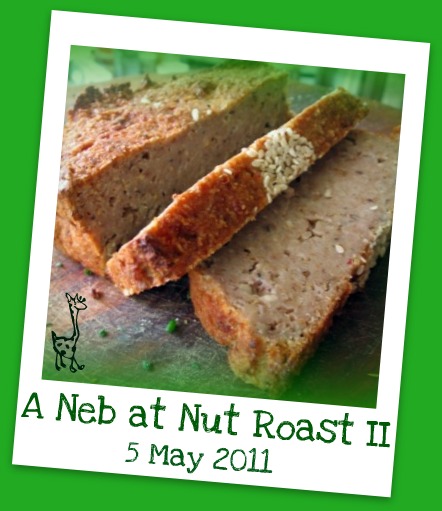
When Johanna announced she was holding a Nut Roast event, there was immediately a nut roast in my mind that I wanted to try for the occasion - Mrs Myrtleberry's Roast from World Vegetarian Classics by Celia Brooks Brown. What I didn't know at this stage was the number of attempts it was going to take me to transform this recipe into a vegan nut roast. 

The recipe takes it's name from the original creator, Mrs Myrtleberry a B&B owner in Devon, England and uses a mixture of nuts that are lightly toasted to bring out their flavour. The other main ingredients are chopped shallots, tomatoes, herbs, eggs and cheese.

My initial thought was that 3 eggs and 150g cheese wasn't going to be hard to substitute and as I didn't believe that the cheese would have much impact on the overall texture, I didn't bother using cheezly the first time. I used 125g silken tofu and a few tablespoons of nutritional yeast for my first attempt which failed miserably. I should correct myself and say that only the texture was a fail, as the taste was very nice and left-overs were enjoyed in sandwiches for days to come. This nut roast was baked for over an hour and still was not firm to the touch. My vegan substitutions were in need of some work!


After the first texture failure, I became more incensed about getting this right. The recipe was perused even more carefully. I realised that I had used tomato passata last time rather than a tin of tomatoes and wondered whether that had made the mixture too runny and led to my texture woes. Perhaps the loaf tin wasn't the right choice? Did I have too many other roasting vegetables competing for the heat of the oven? So much to consider...

For the second attempt I used ground flaxseed plus water instead of the silken tofu, and cheezly was included this time. Again the nut roast was baked for an hour and felt pretty firm by this time, however when it was time to slice it up, the middle of the roast was still not firm enough. It was interesting to note that the texture seemed to become firmer as the nut roast cooled down.


A couple of weeks slipped by but there was no way I was going to let this nut roast get the better of me. The second effort was much closer to a satisfactory result so I settled upon making it this way again with an additional filler to assist with soaking up the moisture. There was some cooked brown rice on hand so a cup was added to the mixture. I won't say it turned out perfectly, however it was a pleasing result after so many trials and tribulations. 

Nut roast sandwiches have become popular at home with all of this recent activity so this gives me incentive to keep making them and I'm sure there will be heaps of great new nut roast recipes to try from Johanna's event.


Mrs Myrtleberry's Roast (Adapted from World Vegetarian Classics)

50g cashews
50g almonds
50g walnuts
50g pecans
50g pine nuts
4 small shallots, chopped finely
2 cloves garlic, minced
1 cup cooked brown rice
150g grated cheezly
1 cup tomato passata
2 tablespoons ground flaxseed
1/2 teaspoon dried sage
2 tablespoons (or more) of fresh herbs of your choice (basil, mint, parsley)
salt and pepper, to taste  

Cook the nuts in batches in a dry frying pan. Heat over a medium flame, stirring gently until golden and fragrant. Remove to your food processor bowl and allow to cool. 

Preheat oven to 200C. Line a lamington tin with baking paper and grease with olive oil. Mix the ground flaxseed thoroughly with 6 tablespoons of water and allow to sit for a few minutes.

In a large bowl, mix thoroughly the ground nuts with the shallots, garlic, rice, cheezly, passata, flaxseed/water mixture, dried sage, fresh herbs and salt and pepper. Scoop the mixture into the prepared tin and bake for 1 hour or until firm and golden. Cool slightly, then turn out on to a serving plate and peel off baking paper. Serve with a rich tomato sauce or gravy.

Wednesday, April 20, 2011

Ethiopian Feast (Part 3)


How can I possibly describe how wonderful these curries/stews are? 

The flavours and aromas of Ethiopian food are so unique due to those two special ingredients that were prepared last weekend, Niter Kibbeh and Berbere. The amount of Niter Kibbeh that I used in two of the stews was halved from the recipes. This wasn't due to spice levels as it is the milder component, however I felt that 2 tablespoons of fat per stew was more than enough and this way half of my batch was left-over for another night. As the heat level of the berbere was yet to be determined, I erred on the side of caution and added teaspoons gradually until I was satisfied with the spiciness. 

I made three stews, none of which were particularly complex to put together. After all of the onions, garlic, ginger and vegies were prepped, I made the lentils, followed by the powdered chickpeas and finally the mixed vegies. It is interesting to note that the recipes all begin with an initial step of cooking the onion without any oil until it is softened and then adding the Niter Kibbeh. It feels a bit topsy-turvy when you are so accustomed to heating oil and then cooking onion in it. 

The lentil stew was from World Vegetarian Classics by Celia Brooks Brown, my source for all of the Ethiopian components and the curries/stews. It was the first time I made this one and I probably wouldn't bother with it again which is why I haven't posted the recipe. Unlike the other two, it did not contain any Niter Kibbeh or Berbere. It was nice and had a distinct flavour due to decent amounts of ginger and basil that were included however the other two stews were the stand-outs by a mile.

The stew of spiced powdered chickpeas is definitely the most impressive. For something that contains so little ingredients, it has the most amazing taste. The first time I attempted it years ago, I was shaking my head in disbelief, but was so excited with the outcome. The Niter Kibbeh is the dominant force although I did only use 1/4 of the stated amount of Berbere this time. The mixed vegetable stew is also wonderful and spicy and highly rated in our house.   


The left-overs were on the menu tonight. Although there was no left-over injera to enjoy them with, they were still lovely with some brown rice instead. I have never eaten out at an Ethiopian restaurant, it is something I am particularly interested in doing as I would love to try the injera and their authentic stews.  

Vegan Dad also seems quite enthused about Ethiopian cooking and has several recipes on his blog. I might have to give one of his stews a try next time for something different...

Ye'atakilt W'et (Spicy Mixed Vegetable Stew) (Adapted from World Vegetarian Classics)

1 large red onion, finely chopped
2 tablespoons Niter Kibbeh
2 garlic cloves, finely chopped
1 tablespoon Berbere
1 tablespoon paprika
100g green beans, cut into bite sized pieces
3 small carrots, cut into bite sized pieces
1/2 head cauliflower, cut into small florets
2 tomatoes, seeded and chopped
4 tablespoons tomato paste
500ml vegetable stock
salt and pepper
fresh parsley, finely chopped

Heat a large saucepan with a lid over a medium heat and add the onion (without any oil). Cook, stirring until soft. Add the niter kibbeh, garlic, berbere and paprika and cook for 2 minutes. Stir through the beans, carrots and cauliflower until well coated with the onion and spice mixture. Cover and cook for 5 minutes, stirring occasionally.

Add the tomatoes, tomato paste and stock. Bring to the boil, then reduce the heat and simmer uncovered, until the vegetables are tender. Season with salt and pepper and stir in the parsley.


Yeshiro We't (Stew of spiced powdered chickpeas) (Adapted from World Vegetarian Classics)

1 red onion, finely chopped
2 tablespoons Niter Kibbeh
4cm piece ginger, finely chopped or grated
2 garlic cloves, finely chopped
2 teaspoons Berbere
2 teaspoons nigella (black cumin, kaloonji) seeds 
500ml vegetable stock
1/4 cup besan (chickpea flour)
salt and pepper

Heat a saucepan over medium heat. Add the onion (without any oil) and stir-fry until soft and brown. Reduce the heat and add the niter kibbeh, ginger, garlic, berbere and nigella seeds. Cook, stirring constantly, until the garlic is golden. Add the stock and bring to the boil, then reduce the heat to a simmer.

Mix the chickpea flour with enough cold water to make a smooth, pourable paste. Gradually drizzle the chickpea paste into the simmering mixture ensuring that you keep stirring constantly to avoid lumps. Simmer for about 30 minutes, or until very thick. Season with salt and pepper.  

Monday, April 18, 2011

Ethiopian Feast (Part 2)

Total and utter deliciousness!!! That's the best way to sum up our Ethiopian meal but even that seems to understate how good it was. So different to other curries and the injera bread was fantastic. I had serious doubts that the bread was going to turn out as the mixture seemed quite thick initially. Over the course of three days of fermenting it thinned out a little.  

This is how it looked after one full day...


After the second day, there were more bubbles present as well as more water separating.


And here is a shot of one frying in the pan. As I don't own a huge non-stick frying pan, I made the injera smaller rather than larger which made them easier to handle. I won't lie and say every piece turned out perfectly as the temperature of the frying pan was too hot initially so a couple were a little burnt on the bottom. I was happy with an 80% success rate on my first attempt.


The recipe seemed to feed a lot of people so I halved it for the three of us in case I made a mess of it or it didn't keep well. In hindsight, I should have made the full recipe which is posted below as we have so many left-over curries. I'm not sure if I can restrain myself from the left-overs for 3 days in order to make another half batch of Injera. Next time a full batch of Injera will definitely be made.

Now I have given you the know-how on the Berbere spice mix, the Niter Kibbeh spiced butter and Injera, there is only thing left to talk about - the curries. Stay tuned...

Injera (Sourdough flatbread) (From World Vegetarian Classics)

300g (2 1/3 cups) strong white bread flour
100g (2/3 cup) wholemeal self-raising flour
7g dried yeast
625ml (2 1/2 cups) warm water
1/2 teaspoon bicarbonate of soda
1 teaspoon salt

Select a large ceramic, glass or plastic bowl, which will allow the batter enough room to rise. Combine the flours and yeast in the bowl. Stir in the warm water and mix to a fairly thin, smooth batter. Cover with a clean damp cloth and let the mixture sit for a full 3 days at room temperature, stirring once a day - it will bubble and rise.

When ready to cook the injera, stir in the bicarbonate of soda and salt into the mixture and leave to stand for 15 minutes. 

Heat a large non-stick frying pan over a medium heat until a drop of water bounces on the surface. Use a 1/2 cup measure to scoop the batter and pour into the hot pan, swirling quickly to coat the surface from the centre outwards - lots of little holes will form immediately. Cook until the surface of the pancake is dry; do no flip or allow to brown underneath - it should be soft and pliable. Remove to a warmed plate and cook the remaining Injera. 

Sunday, April 17, 2011

Ethiopian Feast (Part 1)

On Friday night whilst flicking through cookbooks I was inspired to have another go at making Ethiopian curries. It is probably close to 2 years since I last had a stab at some Ethiopian cuisine and it was so spicy, flavoursome and different to other curries that it was thoroughly enjoyed by all. I haven't bothered making injera bread previously but after reading recent restaurant reviews of Ethiopian restaurants I decided to give it a try this time.     

The injera dough is very simple to prepare, there is no kneading required and a quick mix results in a thick batter. The downside is that it takes 3 days of fermenting (with a quick stir every day) before it is ready for use. In the meantime there were some other vital Ethiopian staples that needed to be prepped like the fiery Berbere spice mix and Niter Kibbeh, a spiced clarified butter.

Some of my spices were almost running out and others not used as frequently were well past their best before dates, so I did a stock-up of fresh spices from my local Indian grocer. 


Armed with these goodies, I went about making the spice powder first and regretfully forgot to  take a photo as the whole spices were roasting away. The smell coming from the kitchen was amazing. After the roasted spices cool down, it's only a matter of grinding them with a few other ground spices and placing the mixture into an airtight container.


The clarified margarine is also fairly straight-forward. After the margarine has melted, it is simmered for 20 minutes along with onions, garlic, ginger and spices. My only issue was that I couldn't locate my cheesecloth or anything similar for straining the margarine. I resorted to carefully using coffee filter bags, however this needed to be done in a few batches as the bags broke a couple of times. Suffice to say, my clarified margarine has a few extra bits and pieces.  


Now that these two basics are out of the way and the injera dough has only one day to go, I'm really looking forward to dinner tomorrow night. There are 2 or possibly 3 curries that will be on the menu, mixed vegetable, powdered chickpeas and a lentil one if I have enough time. I'll follow up with some more Ethiopian recipes in a day or so!

Berbere (From World Vegetarian Classics)

2 teaspoons cumin seeds
8 cloves
1 teaspoon cardamom seeds (not pods, seeds from the pods only)
1/2 teaspoon black peppercorns
1 teaspoon fenugreek seeds
1 teaspoon coriander seeds
8 small red dried chillies (1 used 4 medium sized ones)
1/2 teaspoon ground ginger
1/4 teaspoon allspice
1/4 teaspoon turmeric
1 teaspoon salt
1/4 teaspoon cinnamon
3 tablespoons paprika

Toast the cumin seeds, cloves, cardamom, peppercorns, fenugreek, coriander seeds and chillies in a dry frying pan over a medium heat, shaking the pan frequently, until lightly coloured. Leave to cool, then grind in a spice grinder with the ginger, allspice, turmeric, salt, cinnamon and paprika until a fine powder forms. Store in an airtight container.

Niter Kibbeh (From World Vegetarian Classics)  

250g unsalted butter dairy-free margarine
1 small onion, finely chopped
1 garlic clove, finely chopped
1cm piece ginger, peeled and grated
1/2 teaspoon cardamom seeds 
1 cinnamon stick, about 7.5cm long
2 cloves
1/4 teaspoon freshly grated nutmeg
1/4 teaspoon fenugreek seeds
1/4 teaspoon turmeric
1/2 teaspoon dried basil

In a small saucepan, gradually melt the margarine and bring it to the boil. Add the onion, garlic, ginger, cardamom, cinnamon, cloves, nutmeg, fenugreek, turmeric and basil and reduce the heat to a simmer. Simmer over a very low heat, making sure there is no sign of burning, for about 20 minutes, or until the solids fall to the bottom.

Pour the liquid through a cheesecloth into a container. Discard solids. Leave to cool completely and store in the refrigerator for up to 2 months.  

Tuesday, March 8, 2011

Glamorgan Sausages (Selsig Morgannwg)


This recipe has few ingredients and at first glance appears like it could be rather bland, however it is one of the many gems that I have made several times from World Vegetarian Classics by Celia Brooks Brown. Given to me as a gift from my sister-in-law, this was one of the first vego cookbooks to adorn my shelves. Each chapter has an interesting introduction about the cuisine of the region followed by a focus on some dominant ingredients. Another thing to love is each recipe has it's own introduction some of which contains interesting facts or history, like the following...

"The true original vegetarian sausages with no high-tech meat mockery, these aren't far off modern 'analogue meat' and have a remarkable texture and flavour. In his diary of Welsh adventures from 1862, Wild Wales, George Borrow ate them in Glamorganshire, South Wales. Waking up to a miserable morning and having to put on still-wet clothes, the sausages cheered him up: 'The breakfast was delicious, consisting of excellent tea, buttered toast and Glamorgan sausages, which I really think are not a whit inferior to those of Epping.' (Epping sausages were a renowned pork sausage of the time.)"

Every time I pull out this book and browse to the Glamorgan sausage recipe, I always read about George Borrow's vego sausage experience in 1862 and it never fails to bring a smile to my face.

A few vegan substitutes were required this time around and I was hoping that the sausages would still work equally as well as their vegetarian counterpart. Ground flax seeds mixed with water were substituted for the eggs, soy milk for the milk, and cheezly plus nutritional yeast for the cheese.

The sausages did turn out just as nice as I previously recalled them to be. As bread is one of the major components of the recipe, they aren't really the type of sausage that you would want to have in a piece of bread. They are best served along with some mashed potatoes and veg, roasted vegies or salad. Fried onions are also a great compliment and we have always found that a good chutney/relish makes the best topping.

Glamorgan Sausages (Adapted from World Vegetarian Classics)

3 cups fresh breadcrumbs
1 leek (white part only), finely chopped
50g grated cheezly
2 tablespoons nutritional yeast
1 tablespoon fresh parsley, chopped
1/2 teaspoon dry mustard powder
2 tablespoons ground flax seeds, mixed with 6 tablespoons water
1/4 cup plain flour
1/2 cup soy milk
1/2 cup cornflake crumbs or packaged breadcrumbs
Olive oil, for frying

Mix the fresh breadcrumbs, leek, cheezly, nutritional yeast, parsley, salt, pepper and mustard in a large bowl. Stir through the flax seeds/water mixture until well combined. Test the mixture by squeezing a little in your palm, If it's too crumbly to bind together, drizzle in a little soy milk.

Divide into 10-12 balls, then form each ball into a sausage shape. Toss each sausage in flour, shaking off the excess, then dunk into soy milk and coat with the cornflake/bread crumbs. Place the sausages on a plate and refrigerate for 20-30 minutes.

Heat some oil in a frying pan over low-medium heat or warm up a BBQ grill. Add the chilled sausages and cook, turning gently until golden on all sides.

Serve with tomato relish/chutney, or tomato/BBQ sauce also works well.